✗ Not vegan E120 (carmine) is never vegan. It is a red pigment extracted from cochineal scale insects — roughly 70,000 of them are killed and dried for every pound of dye. Unlike ambiguous additives, there is no plant-derived version of E120. Ever.
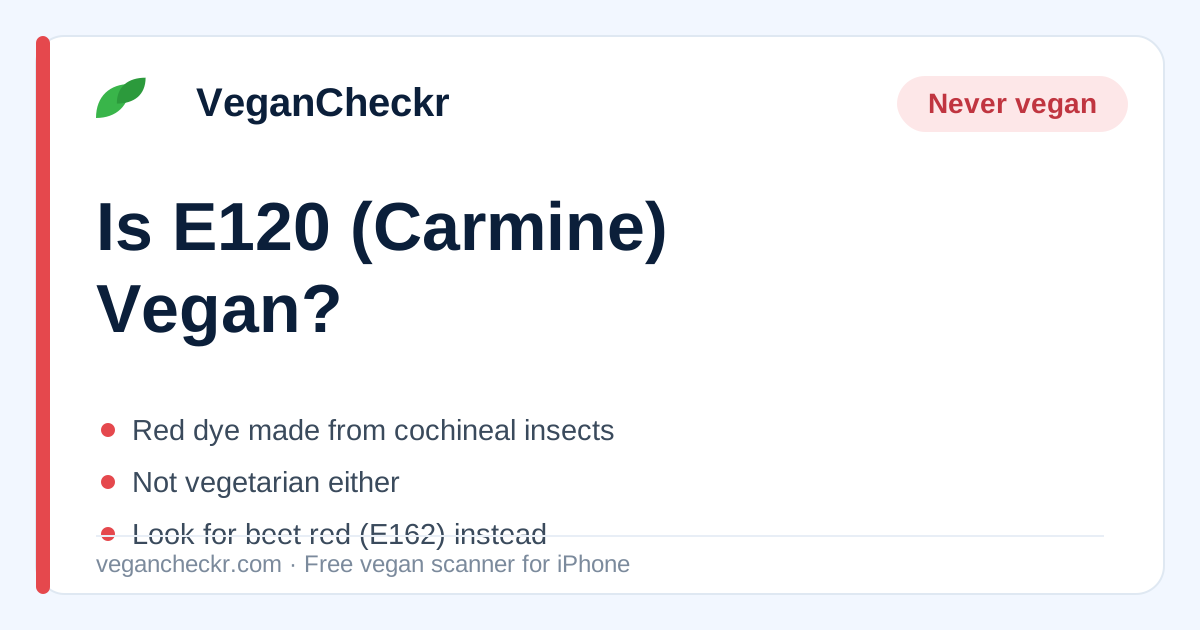
That makes carmine unusual. Most flagged E-numbers — like E471 or E322 — can come from plants, so the honest answer is "check the source". E120 has exactly one source: the bodies of insects. If it's on the label, the product is off the table.
What is E120, exactly?
E120 is the EU additive code — assigned under Regulation (EC) No 1333/2008 — covering cochineal, carminic acid and carmines. All three are versions of the same red pigment, produced by the cochineal insect (Dactylopius coccus), a tiny scale insect that lives on prickly pear cacti.
The females produce carminic acid as a chemical defense, and it's a spectacular red. To harvest it, farmers brush the insects off the cactus pads, kill them with hot water, steam or sun-drying, then dry and grind them. According to Encyclopaedia Britannica, it takes about 70,000 insects to make a single pound of cochineal — north of 150,000 per kilogram. Peru produces the large majority of the world's supply, much of it gathered by small farming families.
You'll see the same pigment under several names depending on how refined it is:
- Cochineal extract — the cruder coloring made directly from the dried insects.
- Carminic acid — the pure pigment molecule itself.
- Carmine (or carmines) — the purified "lake" pigment refined from carminic acid; the most common form in food and cosmetics.
Why carmine is never vegan — or vegetarian
The vegan case needs no nuance: the dye is processed animal bodies. There is no certification, no "ethically sourced" variant and no processing step that changes that.
Carmine also fails most definitions of vegetarian. Vegetarianism excludes ingredients that require killing an animal — that's why animal rennet and gelatin are out — and insects are animals. A strawberry yogurt colored with carmine is no more vegetarian than a gelatin gummy. Some labels lean on the word "natural colors" here, and it's technically true: carmine is natural. It's just natural and made of insects.
"Natural color" tells you nothing about whether a red is vegan. Carmine is perfectly natural — only the specific name on the label tells you whether the color came from a beet or an insect.
What foods contain carmine?
Carmine shows up wherever a stable pink-to-red shade is needed. Strawberry and cherry dairy products are the classic hiding spot, but it ranges much wider — including into your makeup bag.
| Category | Typical products | Label names to watch |
|---|---|---|
| Dairy & desserts | Strawberry yogurt, cherry yogurt, ice cream, flavored milk drinks | Carmine, cochineal extract, E120 |
| Candy & confectionery | Red gummies, jelly sweets, sprinkles, red icing and glazes | Carmines, Natural Red 4, E120 |
| Drinks | Berry juice drinks, red sodas, some aperitifs and liqueurs | Cochineal, carminic acid, E120 |
| Savory foods | Some processed meats, sauces, jams and fruit fillings | Carmine, E120 |
| Cosmetics | Lipstick, blush, nail polish | Carmine, CI 75470 |
The most famous carmine story is Starbucks: in 2012, a barista revealed that the chain's Strawberries & Crème Frappuccino was colored with cochineal extract. After weeks of pressure — much of it from vegans — Starbucks switched to lycopene, a tomato-derived red. Proof that plant-based reds work fine, even at massive scale.
Candy is the other big carmine territory. Recipes change constantly and vary by country, which is why we keep dedicated breakdowns for products like Haribo gummy bears and Skittles up to date.
 Check it in seconds with VeganCheckr
You don't need to memorize five aliases for insect dye — the scanner knows them all:
- Open VeganCheckr and tap Scan, then point your camera at the product barcode.
- No barcode? Use the ingredient label scan to photograph the printed ingredient list instead.
- Read the verdict — if E120, carmine or cochineal is present, it's flagged by name with the reason.
How to spot carmine on a label
Carmine travels under more names than almost any other animal ingredient. Scan the ingredient list for any of these:
- E120 (EU and many other regions)
- Carmine or carmines
- Cochineal or cochineal extract
- Carminic acid
- Natural Red 4 or Crimson Lake
- CI 75470 (the color index number, common on cosmetics)
Labeling law is on your side here. In the US, the FDA has required since January 5, 2011 that all foods and cosmetics declare cochineal extract or carmine by name — it can no longer hide behind "artificial color" or "color added". The rule exists because carmine can cause allergic reactions, including rare anaphylaxis. In the EU, it must appear as E120 or its full name.
That still leaves the burden on you to recognize the aliases, which is exactly the skill our guide to reading food labels as a vegan builds. And carmine is only one entry on a long list — see our full rundown of E-numbers that are not vegan for its companions, like shellac (E904), another insect-derived glaze.
Is carmine safe — and does it matter?
For completeness: the European Food Safety Authority re-evaluated E120 in 2015 and maintained an acceptable daily intake of 5 mg per kilogram of body weight, so it remains an authorized additive in the EU. The main documented risk is allergy, which drove the FDA's by-name labeling rule.
But for vegans, safety was never the question. E120 is a purely ethical red line, and it's one of the easiest to enforce — because unlike many hidden animal ingredients, it must now be named on the label.
Vegan alternatives to carmine
Every shade carmine produces can be matched by a plant-based colorant. If a brand still uses insects, it's a formulation choice, not a necessity.
| E-number | Colorant | Source | Notes |
|---|---|---|---|
| E162 | Beetroot red (betanin) | Beets | Vivid pink-red; fades with heat and light |
| E163 | Anthocyanins | Red cabbage, grape skins, elderberries | Red in acidic products, purple at higher pH |
| E160c | Paprika extract | Paprika peppers | Orange-red; common in sauces and seasonings |
| E160d | Lycopene | Tomatoes | The red Starbucks switched to in 2012 |
The honest trade-off: carmine is exceptionally stable across heat, light and pH, which is why food technologists cling to it. Plant reds need a bit more care in formulation. But as more brands reformulate, spotting E162 or E163 on a red product is increasingly a green flag — literally.
Never get caught by carmine again
Make E120 a permanent red flag on your phone:
- Add carmine to your personal avoidance alerts so every scan warns you the moment it appears.
- Scan your usual strawberry yogurt or red candy — if it's flagged, check the suggested alternatives in the same category.
- Save the clean products to your list; your scan history works offline, so it's there in any supermarket aisle.
FAQ: E120 and carmine
Is carmine vegetarian?
No, by most definitions. Insects are animals, and producing carmine kills them in enormous numbers. Vegetarianism excludes ingredients that require killing an animal, so carmine fails the test just as gelatin does. Some certification bodies explicitly list E120 as neither vegan nor vegetarian.
Is cochineal extract the same as carmine?
They come from the same insect but differ in processing. Cochineal extract is the cruder coloring made from the dried, ground insects, while carmine is the purified pigment (a lake of carminic acid) refined from it. Both fall under E120 in the EU, and neither is vegan.
Is E120 safe to eat?
EFSA re-evaluated E120 in 2015 and kept its acceptable daily intake of 5 mg per kg of body weight, so it remains authorized in the EU. However, it can trigger allergic reactions, including rare cases of anaphylaxis, which is why the FDA requires it to be declared by name on US labels. For personal health concerns, speak to a qualified professional.
Why do brands still use carmine instead of plant-based reds?
Stability. Carmine holds its color through heat, light and pH changes better than most plant-based reds — beetroot red fades when heated, and anthocyanins shift shade with acidity. That processing advantage is why carmine survives in products where a plant dye would discolor, even though vegan alternatives exist for nearly every use.
Check any product in seconds
VeganCheckr scans barcodes and ingredient labels, flags hidden animal ingredients and E-numbers, and shows you the evidence. Free on the App Store.

 Scan with your iPhone camera